
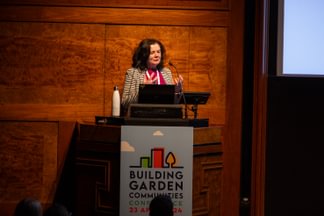
This was the question posed by Fionnuala Lennon, Head of New Settlements & Garden Communities at Homes England in her closing keynote address to 180 delegates at this year’s Garden Communities Conference at RIBA, curated by White Label.
One answer is that they brought us civilisation, civitas being the Latin for city. As Fionnuala explained, unlike the sprawling settlements of wooden houses with thatched roofs built on hillsides by our Iron Age ancestors, Roman cities, the first of which in Britain was Camolodunum, the modern Colchester, were built of bricks and mortar which would be recognisable to us today. Roman cities were built on a grid plan, which allowed for ease of movement and made expansion more practical. At the intersection of major streets, there was an open public space – the forum – which was the heart of the city. Ahead of its time, it was a multifunctional space used for the market, administrative purposes and social and religious gatherings. The forum was surrounded by buildings used for public events, theatres and baths. With an emphasis on functionality, Roman cities provided basic necessities such as paved roads, water and sewage. The cities were built to allow for different tenures and densities: the wealthy lived in townhouses, while the less wealthy lived in apartments with higher densities and shared facilities. The Romans understood that people wanted to interact, to find their way round and to access public facilities. Their approach was holistic, ambitious and people centred.
Later there have been other city and town building movements based on the needs of their time, from the Victorian model villages such as Saltaire, Port Sunlight and Bourneville which provided schools, chapels and easy access to work. The Garden City movement followed and then later came new towns such as Milton Keynes. What these settlements had in common was that they understood the dynamic social and economic factors of the time and had a holistic approach, with the needs of people at their heart.
Fionnuala concluded by pointing out that there is a garden community, Tendring, located just outside Colchester. Although the ancient Romans wouldn’t recognise modern Colchester, many of the principles of creating successful communities which the Romans understood so well are in use in today’s garden communities. In short, the Romans provided us with a model for placemaking.
